
FAF – The Universal AI Context Format for Developers
FAF helps developers organize project knowledge, streamline documentation, and provide consistent context across AI tools for faster, smarter development.
12K+
Developers580+
Projects98%
Satisfaction50+
Integrations
What Is FAF?
FAF (Formatted AI Context) is an open-source universal context format designed specifically for AI-powered development workflows. It creates a consistent way to define, organize, and share AI context across coding assistants, documentation systems, and collaborative teams.
- Single source of truth for all AI interactions in your project.
- Human-readable YAML and JSON structure that works with version control.
- Compatible with modern AI coding assistants and development platforms.
- Reduce onboarding time and improve collaboration across engineering teams.
Why Modern AI Projects Need FAF
As AI tools multiply, developers face a growing challenge: fragmented context, inconsistent prompts, and wasted hours re-explaining project requirements to every new AI assistant and workflow.
Fragmented Context
Every AI tool uses different prompt formats and context structures. Teams often repeat the same project details across multiple assistants, creating inefficiencies and inconsistencies.
Team Inconsistency
Without a shared standard, every contributor communicates differently with AI tools. This often results in unpredictable outputs and inconsistent project quality.
Time Waste
Developers spend valuable hours rewriting prompts and rebuilding context. FAF eliminates this overhead with reusable and version-controlled context files.
Key Features of FAF
Six powerful capabilities that make FAF the essential tool for AI-powered development teams worldwide.
Universal Context Schema
One standardized format that works across AI tools and platforms. Write once, use everywhere without repetitive rewrites.
Version Control Ready
Every FAF file is Git-friendly, making it easy to track changes, review updates, and collaborate efficiently.
Multi-Platform Integration
Connect with AI coding assistants and development tools while maintaining consistent context everywhere.
Context Validation Engine
Built-in validation helps catch context issues before they affect AI outputs and team productivity.
Modular Context Blocks
Build complex workflows from reusable context components and keep prompts organized at scale.
Team Collaboration Mode
Enable structured teamwork with shared context libraries, role-based workflows, and review processes.
How FAF Works
Three simple steps to transform your AI development workflow from chaotic to systematic.
1. Define Your Context
Create a .faf file inside your project. Define technologies, coding standards, AI instructions, and reusable context blocks using a structured format.
2. Validate & Build
Run the FAF validator to verify structure and completeness. Resolve imports, merge modules, and generate platform-ready context automatically.
3. Deploy & Collaborate
Push your FAF file to Git repositories and share it across teams. AI tools instantly receive validated context that stays synchronized everywhere.
FAF File Structure Overview
# project.faf — Root context file

faf_version: "2.4"

project:
  name: "my-saas-app"
  description: "AI-powered analytics"

stack:
  frontend: "Next.js 14"
  backend: "Node.js + Fastify"
  database: "PostgreSQL"

ai_rules:
  - "Prefer server components"
  - "Use Zod for validation"

imports:
  - "./docs/api.faf"
  - "./docs/style.faf"
Structure Breakdown
Schema version for compatibility checks across all FAF-powered tools and platforms.
Core project metadata including name and description for AI context identification.
Technology stack declarations for AI awareness — frontend, backend, and database layers.
Behavioral constraints and coding preferences that guide AI-generated outputs precisely.
Modular context files to include and merge — keeping your FAF structure DRY and scalable.
FAF Benefits for Developers
Discover how FAF improves AI-powered development workflows with better consistency, lower costs, and stronger collaboration.
Eliminate Context Drift
Keep AI responses aligned with your project’s current state. Reduce outdated suggestions and maintain consistent context across tools.
Onboard in Minutes
New developers instantly receive complete project context, helping them become productive from the very first day.
Reduce AI Costs
Focused context reduces token usage and lowers operational costs across modern AI providers and assistants.
Consistent Output Quality
Standardized context ensures reliable, predictable AI outputs regardless of the contributor or platform.
Cross-Tool Portability
Move between AI platforms without losing valuable context. FAF eliminates vendor lock-in completely.
CI/CD Integration
Validate context files automatically within deployment pipelines and catch issues before production.
Supported AI Platforms
FAF integrates seamlessly with all major AI development platforms and coding assistants.
Cursor
GitHub Copilot
ChatGPT / OpenAI
Claude / Anthropic
Windsurf
Aider
Continue.dev
Tabnine
CodeWhisperer
Gemini
Use Cases
From solo developers to enterprise teams, FAF solves real problems across diverse development scenarios.
SaaS Product Development
Maintain consistent AI context across frontend, backend, APIs, and infrastructure. Build faster while reducing rework and misaligned outputs.
Healthcare & Regulated Industries
Apply compliance-focused AI workflows and ensure generated code follows organizational and regulatory requirements.
Open Source Projects
Help contributors understand project context instantly through structured FAF files instead of lengthy onboarding documents.
Enterprise Microservices
Share standardized context across distributed systems, services, and engineering teams for consistent AI assistance.
Why Choose FAF Over Traditional Documentation?
Traditional docs were built for humans. FAF is built for humans and AI — creating a smarter development workflow.
- ✕ Machine-readable structure missing
- ✕ Auto validation unavailable
- ✕ Cross-platform consistency issues
- ✕ Limited reuse and modularity
- ✕ No real-time synchronization
- ✕ Weak CI/CD integration
- ✕ Requires repeated AI prompting
- ✓ Machine-readable YAML/JSON format
- ✓ Built-in validation support
- ✓ Consistent across AI platforms
- ✓ Modular and reusable context blocks
- ✓ Real-time context synchronization
- ✓ CI/CD ready workflows
- ✓ One source of truth for AI tools
FAF in Numbers
Real metrics from real teams using FAF in production environments worldwide.
How Teams Use FAF in Production
FAF helps development teams organize project knowledge, improve collaboration, and provide AI systems with reliable context throughout the software lifecycle.
Managing Large Projects
Centralize architecture details, requirements, workflows, and documentation into a structured format that scales with growing applications and development teams.
Multi-Team Collaboration
Create a single source of truth where developers, designers, product managers, and stakeholders work from the same project context and requirements.
AI-Assisted Development
Provide structured context to coding assistants and AI platforms so generated outputs remain accurate, consistent, and aligned with project objectives.
Knowledge Preservation
Retain critical project decisions, architecture insights, and operational knowledge even when team members change or documentation evolves.
Continuous Documentation
Keep documentation synchronized with active development so teams and AI tools always work with current and reliable project information.
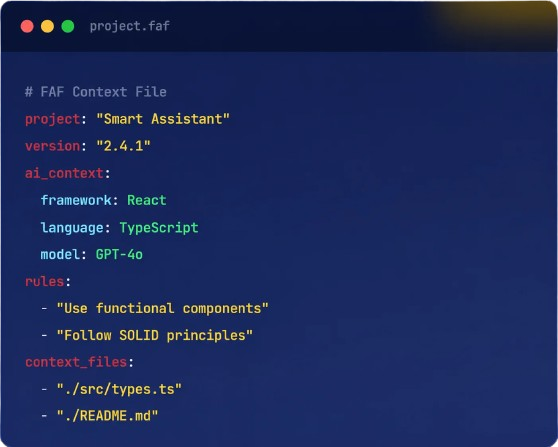
FAF in Action
Explore realistic examples showing how FAF structures project context, documentation, and AI workflows.
name: “Smart Assistant”
framework: React
language: TypeScript
ai_rules:
– Use functional components
– Follow SOLID principles
FAF Configuration Example
Structured project information that helps AI understand requirements instantly.
├─ 📁 docs/
├─ 📁 src/
├─ 📁 context/
├─ 📄 project.faf
└─ 📄 README.md
Project Structure Overview
Unified organization for files, documentation, and development resources.
✓ Project Loaded
✓ Architecture Loaded
✓ Coding Rules Loaded
✓ Documentation Loaded
AI Context Management
Reusable context allows AI tools to provide more accurate responses.
Designer → FAF
Manager → FAF
AI Tool → FAF
Single Source of Truth
Team Collaboration Scenario
Centralized project knowledge keeps teams aligned and productive.
Pros and Cons of FAF
We believe in transparency. Here’s an honest look at FAF’s strengths and current limitations.
Pros
- ✓ Eliminates context fragmentation across AI tools — write once, use everywhere.
- ✓ Git-native format makes version control and collaboration seamless.
- ✓ Modular architecture keeps context DRY and maintainable as projects grow.
- ✓ Built-in validation catches errors before they waste AI tokens.
- ✓ 50+ platform integrations with auto-detection and zero vendor lock-in.
- ✓ Open-source ecosystem with active community contributions.
- ✓ Can reduce AI token costs significantly through focused context delivery.
Cons
- ✕ Learning curve for teams new to structured AI context management.
- ✕ Requires initial effort to create comprehensive FAF files.
- ✕ Some niche AI tools still depend on community-maintained adapters.
- ✕ Large monorepo contexts can become complex without modularization.
- ✕ Major schema updates may occasionally require migration work.
FAF vs Other AI Context Formats
See how FAF compares to alternative approaches for managing AI context in development workflows.
| Feature | FAF | .cursorrules | Markdown Docs | Plain Prompts |
|---|---|---|---|---|
| Cross-Platform | ✓ All | ✕ Cursor Only | ~ Partial | ✕ No |
| Machine Validated | ✓ Built-In | ✕ No | ✕ No | ✕ No |
| Modular Imports | ✓ Yes | ✕ No | ~ Manual | ✕ No |
| Version Control | ✓ Native | ✓ Native | ✓ Native | ✕ No |
| Team Features | ✓ Advanced | ✕ Basic | ~ Manual | ✕ No |
| CI/CD Ready | ✓ Yes | ✕ No | ✕ No | ✕ No |
| Token Efficiency | ✓ Optimized | ~ Variable | ✕ Verbose | ✕ Wasteful |
| Open Source | ✓ MIT | ~ N/A | ✓ N/A | ✓ N/A |
Community Feedback
Real feedback from developers, engineering teams, and open-source contributors using FAF in production workflows.
Sarah Chen
Lead Engineer, StripeMarcus Rivera
CTO, DataFlow IncAisha Patel
OSS Maintainer, VueFlowFrequently Asked Questions
Find answers to the most common questions about FAF, including its purpose, features, implementation, compatibility, and benefits for AI-assisted development.
Still have questions? We’re here to help you get started with FAF.
Ask a Question