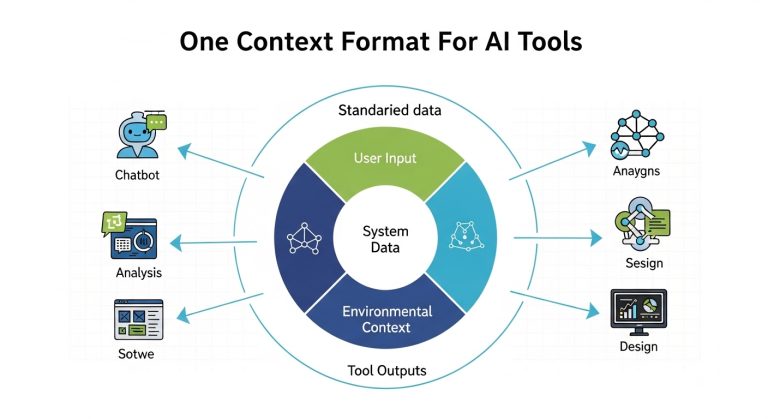

Universal AI Context Format For Developers
Artificial intelligence development is becoming increasingly dependent on structured, portable, and reusable context systems that can move seamlessly across tools, models, and teams. As projects scale, developers face growing challenges in maintaining consistent prompts, metadata, and contextual signals that keep AI outputs reliable. The Universal AI Context Format emerges as a standardized approach aimed at solving these issues by unifying how context is written, stored, and shared across development ecosystems. It helps teams reduce fragmentation, improve interoperability, and build AI systems that behave more predictably across environments.
Foundations of Universal AI Context Format
Standardized Context Structure
The Universal AI Context Format introduces a consistent structure for representing AI context across applications. Instead of ad hoc formatting, developers can define predictable schemas that organize prompts, instructions, and metadata. This improves clarity, reduces ambiguity, and ensures that AI systems interpret inputs consistently across different platforms and models.
Cross-Platform Compatibility
One of the key strengths of this format is its ability to work across multiple AI frameworks. Developers can move context between tools without rewriting or restructuring it. This compatibility reduces integration effort, improves workflow continuity, and enables smoother transitions between development, testing, and production environments.
Model-Agnostic Design
The format is designed to remain independent of any specific AI model. Whether teams are using large language models, multimodal systems, or fine-tuned solutions, the context remains usable. This flexibility helps organizations avoid vendor lock-in and maintain long-term adaptability in rapidly evolving AI ecosystems.
Structured Metadata Handling
Context is not limited to prompts alone; metadata plays a crucial role in AI behavior. The Universal AI Context Format organizes metadata such as roles, constraints, and system instructions in a structured way. This ensures better interpretability and more controlled AI responses across different use cases.
Scalable Context Organization
As AI applications grow, managing context becomes increasingly complex. This format provides a scalable approach that supports expanding datasets, evolving instructions, and multi-layered workflows. Developers can maintain order even in large systems, improving maintainability and reducing operational overhead.
Core Components of the Format
Instruction Layer Definition
The instruction layer defines what the AI system is expected to do. It separates system-level rules from user inputs, ensuring clear boundaries in behavior. This separation improves consistency and helps prevent conflicting instructions from affecting model outputs.
Contextual Memory Blocks
Memory blocks store reusable contextual information that can persist across interactions. These blocks help maintain continuity in AI systems, allowing developers to reuse prior knowledge without repeatedly supplying the same data. This improves efficiency and reduces redundancy in workflows.
Role-Based Segmentation
Different roles, such as system, developer, and user, er are clearly defined within the format. This segmentation ensures that AI models understand the hierarchy of instructions. It helps maintain control over response behavior and improves alignment with intended outputs.
Dynamic Variable Support
The format supports dynamic variables that can be replaced at runtime. This allows developers to create flexible templates that adapt to different inputs while maintaining a consistent structure. It enhances automation and reduces manual intervention in prompt design.
Validation and Integrity Checks
To ensure reliability, the format includes validation mechanisms that check for completeness and structural correctness. These checks help prevent malformed context from reaching AI systems, improving stability and reducing unexpected behavior during execution.
Benefits for Development Teams
Improved Consistency in AI Outputs
By standardizing how context is structured, developers achieve more predictable AI behavior. Consistency improves across prompts, reducing variability and enhancing trust in system responses across different environments and applications.
Faster Development Cycles
Reusable context structures eliminate the need to rebuild prompts from scratch. Developers can quickly deploy standardized formats, accelerating experimentation, testing, and production deployment. This leads to shorter development cycles and faster iteration.

Reduced Integration Complexity
Integrating AI systems often requires significant effort due to inconsistent context formats. The Universal AI Context Format simplifies this by providing a unified structure that works across tools, reducing engineering overhead and simplifying system design.
Enhanced Collaboration Across Teams
Shared context standards make it easier for teams to collaborate. Developers, data scientists, and product teams can all work with the same format, reducing misunderstandings and improving coordination across projects and departments.
Better Maintainability of AI Systems
Structured context is easier to maintain over time. Updates can be applied systematically without breaking existing workflows. This improves long-term system stability and reduces technical debt in AI-driven applications.
Universal AI Context Format Architecture
| Component | Purpose | Impact |
|---|---|---|
| Instruction Layer | Defines system behavior | Ensures control and clarity |
| Metadata Blocks | Stores contextual details | Improves interpretability |
| Memory Layer | Maintains persistent context | Enhances continuity |
| Variable Engine | Enables dynamic inputs | Supports flexibility |
| Validation System | Ensures correctness | Improves reliability |
Integration in Modern AI Workflows
API-Level Implementation
The format can be implemented directly into APIs that serve AI models. This allows structured context to be passed consistently between services. It improves communication between backend systems and AI engines, ensuring predictable behavior across requests.
Prompt Engineering Optimization
Developers can use the format to refine prompt engineering practices. Instead of crafting isolated prompts, they build reusable structures that adapt to different scenarios. This improves efficiency and reduces repetitive design work in AI development.
Multi-Agent System Support
In multi-agent AI systems, consistent context sharing is essential. The format enables agents to exchange structured information without misinterpretation. This improves coordination, task distribution, and overall system intelligence in complex workflows.
Continuous Learning Pipelines
AI systems that evolve require consistent context tracking. The format supports continuous learning pipelines by maintaining structured historical context that can be reused during training and inference processes.
DevOps and MLOps Integration
The format integrates smoothly into DevOps and MLOps pipelines. It ensures that context remains consistent across development, testing, and deployment stages, improving reliability and reducing environment-specific inconsistencies.
Security and Governance Aspects
Controlled Context Access
Security is reinforced by defining clear access rules for context layers. Only authorized systems or users can modify sensitive instructions, reducing the risk of unauthorized changes or prompt injection vulnerabilities.
Auditability of Context Changes
Every modification to the context structure can be tracked and audited. This improves transparency and allows teams to understand how AI behavior evolves, supporting compliance and governance requirements.
Data Isolation Mechanisms
The format supports the separation of sensitive data within context blocks. This prevents unintended data leakage and ensures that confidential information is properly isolated during AI processing.
Compliance-Friendly Structure
Regulated industries benefit from structured and traceable context formats. The Universal AI Context Format helps organizations meet compliance standards by maintaining clear documentation of AI behavior and inputs.
Risk Mitigation in AI Outputs
By controlling how context is structured and validated, the format reduces the risk of unpredictable or unsafe AI outputs. This improves reliability and strengthens trust in AI systems used in critical applications.
Future of Universal AI Context Standards
Expansion of Interoperable AI Systems
As AI ecosystems become more interconnected, standardized context formats will play a central role. The Universal AI Context Format supports interoperability across diverse tools and platforms.
Growth of Multi-Model Environments
Future AI systems will rely on multiple models working together. A universal context format ensures that all models interpret information consistently, improving coordination and performance.
Evolution of Intelligent Automation
Automation systems will increasingly depend on structured context to make decisions. This format provides a foundation for more advanced and autonomous workflows across industries.
Standardization Across the AI Industry
Wider adoption of universal formats could lead to industry standards for context management. This would improve collaboration and reduce fragmentation across AI development ecosystems.
Foundation for Advanced AI Agents
Future AI agents will require structured memory and context handling. The format provides a foundation for building more intelligent, reliable, and scalable autonomous systems.
Challenges in Adoption
Migration from Legacy Systems
Organizations using unstructured prompts may face challenges transitioning to standardized formats. Migration requires careful planning and system redesign to ensure compatibility.
Learning Curve for Developers
Developers must understand the structure and principles of the format. Initial learning may slow adoption but leads to long-term productivity gains.
Tooling and Ecosystem Support
Widespread adoption depends on tool support across AI platforms. Without ecosystem alignment, implementation may require additional engineering effort.
Balancing Flexibility and Structure
Too much rigidity can limit creativity, while too much flexibility reduces consistency. Finding the right balance is essential for effective implementation.
Performance Optimization Considerations
Structured context processing may introduce slight overhead. Optimization strategies are needed to ensure performance remains efficient at scale.
Conclusion
The Universal AI Context Format represents a significant step toward standardizing how developers manage AI context across systems and workflows. By introducing structured, reusable, and interoperable context design, it helps reduce complexity, improve collaboration, and enhance AI reliability. As AI systems continue to evolve, such formats will become essential for building scalable, consistent, and intelligent applications that meet the demands of modern development environments.