FAF Reduces AI Context Fragmentation
AI development has become highly distributed across tools, APIs, models, and teams, but this expansion has introduced a major problem: context fragmentation. When information is scattered across systems, AI outputs become inconsistent, workflows slow down, and collaboration breaks apart. FAF reduces AI context fragmentation by unifying how context is created, stored, and delivered across the entire development lifecycle, enabling smoother and more reliable AI-driven systems.
Causes of AI Context Fragmentation
Disconnected Development Tools
Modern AI workflows often involve multiple platforms that do not share context natively. Each tool stores information differently, which leads to gaps in understanding and inconsistent outputs across systems.
Repeated Context Recreation
Developers frequently recreate prompts and instructions for different environments. This duplication increases the risk of inconsistency and makes it difficult to maintain a single source of truth across projects.
Lack of Shared Standards
Without standardized context formats, teams interpret and structure information differently. This leads to mismatched expectations between systems and reduces overall efficiency in AI development pipelines.
Isolated Team Workflows
Different teams often maintain separate context structures, leading to siloed knowledge. This isolation prevents effective collaboration and creates redundancy in AI system design and implementation.
Inconsistent Data Pipelines
When data flows through multiple uncoordinated systems, context becomes fragmented. This results in AI models receiving incomplete or inconsistent inputs, affecting accuracy and reliability.
FAF Framework for Reducing Fragmentation
Unified Context Architecture
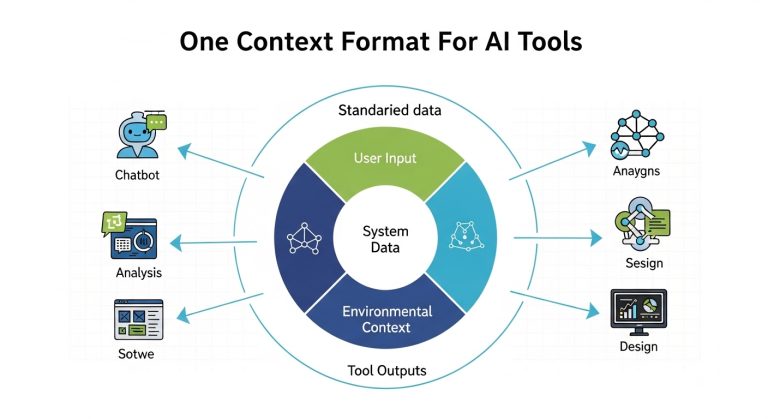
FAF introduces a unified architecture that consolidates all contextual information into a single structured format. This ensures that every AI system accesses the same consistent data regardless of tool or environment.
Centralized Context Repository
Instead of storing context across multiple locations, FAF maintains a centralized repository. This eliminates duplication and ensures that all teams and systems work from the same updated information source.
Standardized Context Schema
FAF enforces a structured schema for representing AI context. This standardization ensures that prompts, metadata, and instructions follow a consistent format across all development workflows.
Cross System Context Synchronization
Context changes are automatically synchronized across all connected tools and platforms. This ensures that updates made in one system are immediately reflected everywhere else, reducing fragmentation risks.
Modular Context Design
FAF breaks context into reusable modules that can be shared across projects. This reduces redundancy and ensures that consistent logic is applied across different AI workflows.
Benefits of Reducing Context Fragmentation
Improved AI Output Consistency
When context is unified, AI systems generate more stable and predictable outputs. This improves reliability and reduces unexpected behavior across applications.
Faster Development Workflows
Developers spend less time recreating or correcting context, allowing them to focus on building features and improving AI functionality instead of managing fragmented information.
Enhanced Team Collaboration
Shared context structures ensure that all team members work with the same information. This reduces misunderstandings and improves coordination across distributed teams.

Reduced System Complexity
A unified context system simplifies AI architecture by eliminating redundant storage and processing layers. This makes systems easier to manage and scale.
Higher Data Integrity
Centralized and standardized context reduces the risk of data loss, inconsistency, or corruption during AI processing workflows.
FAF Context Unification Architecture
| Component | Function | Impact on Fragmentation |
|---|---|---|
| Unified Schema | Standardizes context format | Eliminates inconsistency |
| Central Repository | Stores all context data | Removes duplication |
| Sync Engine | Updates systems in real time | Prevents divergence |
| Modular Blocks | Reusable context units | Reduces redundancy |
| Validation Layer | Ensures structure integrity | Improves reliability |
Role of FAF in AI System Alignment
Single Source of Truth
FAF establishes a single source of truth for all AI context data. This ensures that every system, tool, and team works with the same information without variation.
Consistent Multi-Tool Integration
AI tools often behave differently due to inconsistent context handling. FAF aligns these tools by enforcing a shared structure for all contextual data exchanges.
Streamlined Data Flow
Context flows smoothly through AI pipelines when it is structured and unified. FAF ensures that information moves without fragmentation or loss across systems.
Improved Model Reliability
AI models perform more reliably when they receive consistent inputs. FAF reduces variability in context delivery, improving model stability and accuracy.
Better Cross-Team Coordination
With a unified context, different teams can collaborate more effectively. FAF ensures that developers, analysts, and engineers all operate with the same contextual foundation.
Security and Governance in Unified Context Systems
Controlled Access to Context
FAF enforces strict access controls to ensure that only authorized users and systems can modify or retrieve sensitive context data.
Auditable Context Changes
All modifications to context are tracked, allowing organizations to maintain transparency and traceability across AI development workflows.
Structured Data Protection
Context data is organized in a way that prevents accidental exposure or misuse, improving overall security across AI systems.
Governance Policy Enforcement
FAF aligns with organizational governance policies by standardizing how context is managed, shared, and updated across systems.
Reduced Operational Risk
By eliminating fragmentation, FAF reduces the risk of inconsistent AI behavior caused by outdated or mismatched context information.
Future of Fragmentation-Free AI Development
Unified AI Ecosystems
Future AI systems will rely on unified context frameworks to ensure seamless interoperability across platforms and tools.
Expansion of Real-Time AI Collaboration
Real-time context synchronization will enable faster and more accurate collaboration between distributed AI systems and teams.
Growth of Standardized AI Infrastructure
Standard context formats like FAF will become essential infrastructure components for large-scale AI ecosystems.
Evolution of Intelligent Context Management
AI systems will increasingly manage their own context dynamically using structured frameworks like FAF.
Foundation for Scalable AI Systems
Reducing fragmentation is essential for scalability, and FAF provides the structural foundation for building large, efficient AI systems.
FAQs
What is AI context fragmentation?
It is the problem of scattered and inconsistent context across AI tools and systems.
How does FAF reduce fragmentation?
It unifies context into a standardized and centralized system.
Why is fragmentation a problem in AI development?
It causes inconsistency, inefficiency, and unreliable AI outputs.
Can FAF improve collaboration?
Yes, it ensures all teams work with the same structured context.
Is FAF suitable for large systems?
Yes, it is designed to scale across complex AI environments.
Conclusion
FAF reduces AI context fragmentation by creating a unified, structured, and synchronized system for managing contextual information. It eliminates duplication, improves consistency, and enhances collaboration across teams and tools. By centralizing and standardizing AI context, FAF enables more reliable, scalable, and efficient AI development across modern engineering environments.